1.04.2020

Breaking Rules


Contemplating impending retirement, I revisit works of art created by so many students over the years. What a complete joy and privilege to nurture and witness creativity unfolding. Even after all these years, I wonder at the creative process. It is a dance, the partners, freedom and restriction, taking turns leading the steps, sometimes in sync, sometimes out of step completely. Art projects, in a classroom environment, are like problem sets for critical thinking. The teacher's role is to pose a question, provide some tools and skills, then step back and let it all happen. MUCH easier said than done, to be sure! My favorite admonishment to students, given after project instructions and usually with a wink: "Rules (in the art room) are meant to be broken." 
Over the years, I have discovered that the richest creative moments and art experiences both in the classroom and in my own studio occur when rules are broken either accidentally or intentionally. Nurturing the capacity for students to create, follow and BREAK their own rules is true teaching, far more an art than a science.


Handy Work

It's intensely satisfying to make things with my hands: pie dough, needle point, pencil drawing, painting a wall or a canvas, it makes no difference to me. Most of my students, too, enjoy doing things with their hands: things with yarn like finger knitting, cat's cradle, friendship bracelets. Some kids love to sit at their desk flipping those little skate boards, finger decks, drives me crazy. I toss them in my bottom drawer and give them back after school, so then they bend their id's into finger decks and flip those - they don't make as much noise, so I ignore it. Toys are forgotten anyway once the fun art materials come out. Most kids love playing in clay, and mention finger painting and the class goes nuts.
There's always a kid or two who can't stand getting their hands dirty. Sometimes its a sensory overload for them, a special need they deal with, sometimes they're just very tidy kids. Surgical gloves come in handy.....except some kid always fills them up at the sink...you just have to laugh and keep a mop at hand. 


10.24.2015

Who Knows....

what fun and silly art you will get when you hand kids a hunk of clay and suggest they make a nose? Here are the noses created by my awesome art students at Blue Lake Fine Arts Camp.
And here are some Nosy Bust Up projects created with chicken wire, ceramic noses and spray paint. Pretty fun!


8.07.2014

Head Down, Hoody Up

Head down, hoody up - That's how some middle school students enter the art room on the first day of class. This is NOT where they want to be; what they want to be doing. Sleeping, music, texting, gaming, maybe even reading a good book are all preferable activities. Art class is scary, the potential for leakage of authentic self, great.

First day of school: I will station myself in the hallway, greet and smile, exchange a few hugs with returning students, try for eye contact with the newbies - so hard to reach into, beyond the lacquered shell of young teens. We'll get there, step by tiny step.

Backward portraits are a way to save face for this perpetually embarrassed age group. So is lots of choice within limits. "Freedom is moving easy in harness." I've always loved that quotation despite having to write a timed Senior Essay about it some 35 year ago....

Technology will help me increase options. Have a friend snap your own rear-view portrait and work from your phone or class iPad, or have a friend pose and create a portrait of someone else which feels safer....unless you have to pose.

But when it's all done and up, the pride and fun as we identify who's who, artist and model. After all, everyone likes a little positive attention, even if eye contact is still a challenge.

5.01.2013

Art Style and Art Movement


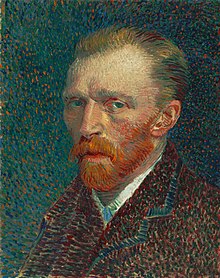
A head and shoulders portrait of a thirty something man, with a red beard, facing to the leftUnderstanding  and describing artist's unique styles is really challenging for middle school students. Today students looked at a work by Vincent Van Gogh and we discussed the unique way in which he used line, color and texture. These elements are pretty easy to discern. But then we discussed the way in which he divides space across the picture plain. That's when things got a little complicated. We muddled our way through together only to end up with confusion once students were tackling these ideas in their groups.
That's kind of how learning goes. Order is replaced with chaos when new learning upsets the 'working model." Then, for a time there is comfort in stasis, only to experience chaos again with new learning. 


2.07.2013

Working Together for MLK's DREAM

In honor of Martin Luther King Jr and in celebration of Black History Month art students at my middle school and a neighboring school district worked together during February to create art. My friend and fellow art teacher, Holly Lampen,  received a grant to support this project and generously invited my students and me to join her in this creative effort. Hundreds of kids at our respective schools painted designs in individual squares on two canvases. The warm and cool toned squares spell out MLK’s iconic word: “DREAM.” Each school is working on two of the large canvases. The schools will soon trade one half of the work of art so that the final work on display at each school will represent the collaborative effort of Wildcats and Pioneers joining together to make art. Thank you, Holly, for the inspired project!

1.23.2013

Color Theory: Hands-On Practice

You're never too old to finger paint, or, in this case, paint by hand! Students had a blast today covering sketchbooks with multi-hued hand prints. I over heard one young man say, "Haven't done that in a few years." In answer, another boy replied, laughing, "I've NEVER done THAT!"
We sometimes forget that not all children come from homes or backgrounds where they have the joy of just playing with paint or nice colored pencils, or even making mud pies in the back yard.
There was a fun twist to this "beginning of the term" activity which required groups to work collaboratively to accomplish the task of covering their sketchbooks with hand prints in primary, secondary and dark and light hues - 8 colors in all. Each group  had five small tubs containing one color of tempera paint: red, yellow and blue, as well as black and white. Each group member took charge of one color. They spread it on their palms and delivered prints to group members' sketchbooks. Then the real fun began as they gently 'high-fived' a classmate, giving palms a little back and forth twist, to create the secondaries as well as at least one light and one dark value of color. They knew they wouldn't be allowed to wash their hands until they were done, so it took some careful planning and coordination.
It was so fun to listen to the kids as they discovered and named the colors they created. There were some surprises such as the 'army' green which resulted from mixing black and yellow tempera. Tomorrow's Art Start questions: Why did black and yellow create a dark green? What does this tell us about the particular black paint we used? What IS black, anyway?

12.30.2012

Process vs Product

I've been thinking a lot about the art making process versus the creation of art product. Bulletin board displays of student work may display the fruit of my teaching labors but do not always represent the great learning that takes place.
Separating my ego from the quality of art on display is not always easy. Let's face it, some artwork produced can be fairly devoid of visual interest, for all but the loving parent at home, yet I know student artists engaged and struggled and came out the other end with an acceptance of new ideas and ways of thinking.
Yes, there are a myriad art projects available on-line that will result in 100% cool-looking objects, but this canned approach to art making isn't really for me. I also don't like to sort out the "best" work to exhibit.
Sometimes, I just hand the staplers to my students and have them plaster the hallways with their work. They love it and it saves me a lot of time. However, it may be best not to try this display approach if you and/or your site administrator are perfectionists!

11.28.2012

Art Stations

I've experimented with using Art Stations -what we used to call "centers" in elementary school-  this fall as a way to engage middle school students by giving them opportunities to make choices and work with friends. The first go around back in September was definitely a fun way to run class. The kids loved the freedom of moving from station to station at their own pace. However, it wasn't the most expedient way to reach my learning targets for the unit. Keeping track of learning targets and student achievement was difficult without adding more testing- something I am loath to do in the art room.

 So, for the second go around with the next unit I improved the system of checking student understanding after each station. However, it took both my student teacher and myself to keep up with the larger classes. I won't have that luxury in a few weeks when my student teacher moves on.

For the third go around I built the 'assessment' into a more rigorous set of expectations for the artistic end-product and also added a quiz: three questions, short written answer. This helps me meet common core literacy objectives. It was apparent from the quiz and the artwork who 'got it' and who didn't. Now, I just have to figure out what I'm going to do about the students who didn't do well on the quiz.

My basic philosophy of teaching and learning is that every kid can have an "A" if they want it. I see no issue with allowing endless re-do's except, of course, the obvious constraints of time and energy!


10.06.2012

Ceramic Pendants

 Students learned about the Elements of Art by studying ancient symbols. I added two ipads to my classroom tools, much to the delight of my students. They found thousands of symbols online at www.symbols.com. A really cool site that allows the user to search symbols in a variety of ways, from the visual attributes to the meanings.
During a week of station work students rotated through six activities exploring signs, symbols and designs through a variety of media such as colored pencil, India ink, oil pastel and tempera paint.
They loved the freedom of moving through the stations at their own pace, working with friends and trying out different media. It was a fun, relaxed time that allowed my student teacher and me to really get to know our students as we had time to talk to individuals and small groups.

After station work the unit culminated with everyone creating several pendants in clay. One could be a modern, everyday symbol and one pendant needed to incorporate an ancient symbol into the overall design. We cut shapes from slabs, allowed them to dry to leather-hard, then carved designs into the clay. A very fun process!
We decided to paint the pendants in acrylic paint rather than glaze as this allowed the students greater control of color and detail.
I was amazed that these 7th and 8th graders, boys and girls alike, enjoyed stringing and beading and walked out of the classroom wearing their pendants! who would have thought this could be cool!


9.09.2012

How Is A Work of Art Like a Toaster?


Wow, made it through another First-Week-Of-School! I love my students. These young teens are so talkative and yet so mute. So, so awkward and yet so sure of themselves. So cool and yet fun and funny. On Thursday we made toast and talked about how a work of art is like a toaster: when all the elements are functioning well the out-come is a complete experience like a a lovely, piece of buttered toast. This silly opening activity was a fun way to introduce the Elements of Art: line, shape, form, space, color and texture.

Breaking Bread together is a time honored tradition of connecting with others. A not so traditional ice breaker activity this week that helped us cool down while building bonds was an ice melting relay race. I gave each table group of 4-5 students an ice cube. The winning group melted their cube first. Such a simple and silly activity. We do not have air conditioning and it was a stifling 90 degrees in the art room with humidity to match. This was a very popular activity that left me with clean art tables!

8.18.2012

Remember Your First Year?

Faithful Followers:
Do you remember being a first year teacher? Equal parts excitement and terror! Although I've been in the classroom for more than twenty years, I still experience happy anticipation and a few jitters at the thought of the first day of school! Below is an excerpt from an email I received a couple of days ago. I'm sure you all have helpful advice and suggestions for Debra. Please take a moment and respond to Debra via the comments link.

Hi!
I am a new art teacher and I am looking for some help and guidance! .....
I will be teaching 6th grade (Art I) and combined classes of 7th & 8th grade (Art II & III). I am just having a hard time figuring out how to distinguish between the two classes and making sure they are not all doing the same thing......

Also, I know the techniques and processes; I am just VERY confused about order and amount of time. I was told I have to have student work ready to enter our county fair by the end of September.....

I am hoping some kind soul will take pity on me and give me some suggestions on order of lessons and amount of time to expect to spend on each. ..... I have found thousands of lessons/projects on the internet and I want to do them all – LOL- but I know there is bound to be a logical scope and sequence I should be following.....

I am just sitting in my classroom trying not to panic as time gets closer....
-Debra

Hi Debra,
I am also in the process of getting ready for the new school year. I am revamping my teaching web sites so a few of the links aren't up to date, yet. Hopefully, by next week I will be ready! Now, on to helping you with your exciting, first year of teaching. First of all, congratulations on getting a job! Now, the answer to your issues around what to teach and how to break down the curriculum between your 6th grade classes and your 7/8 classes is simple, so stop worrying! A certain amount of nervous energy will get you started, but you don't want to burn out before the first day of school!

Here are some thoughts:
  1. DO THE SAME MEDIA WITH ALL CLASSES (with some differentiation for age/ interest/ ability/ state standards.)
  2. Choose YOUR favorite medium (if you're excited, the kiddos will be excited.)
  3. Then, choose several open-ended projects of various levels of difficulty. For instance, I will start with clay (my fav and middle school kids, as well) My classes are combined 7/8. Your 6th graders could do a simple slab bowl, while your 7/8 classes could make lidded boxes. A 2D example might be to have the kids do self-portraits, 6th grade could do "backwards" portraits while 7/8 would do more traditional portraits. So, your drawing lessons for 6th would focus on, for example, line, texture and space, while with upper classes you could add proportion. This would start to give you a progression for future years. You can do this with any media and any project.
  4. Then, pull your learning targets or lesson objectives out of the project, so, look at your state standards, break them down into specific lesson objectives eg what your students will know and be able to do from the lesson. Choose maybe two or three to address in your first unit. The learning targets will be similar for each of the grades, but the assessment criteria will be more in depth as the students get older. Just adjust the quantity/ assessment criteria for 6th versus your 7/8 class.
  5. Over the course of the year you will have time to start to think about future years. If you design a three year rotation on projects, then you won't have to worry about repeat students. For instance, if you start this year with portraiture, then next year your first unit could be printmaking. You use the same learning targets adjusted by grade level, but different projects/ media. Year four you start the sequence over again.


8.14.2012

Art Centers

I am reworking some Power Point slides from my clay pendants unit to create six elements of art "Exploration Stations" for independent student work prior to beginning the clay pendants project.

I am planning for this to be my opening unit when school starts in September. This is a big experiment. I'm sure management will be the biggest issue, but I'm hoping that students will enjoy the freedom of moving from station to station at their own pace.

Pictured here are a few of the stations I intend to set up. A link to the pdf of all six stations along with some of the lesson resources is available on my classroom site, Ms. Wilson's Art Room. Or go straight to the pdf here. Just be forewarned, the art centers are NOT teacher tested yet. Check back sometime later this fall and I will let you know how it's going! To access the complete lesson click on the clay pendants unit above.

8.12.2012

Exploration Art Stations

Ceramic Peace Pendant, 8th Grader
Days are shorter, nights are cooler, the garden harvest has slowed. Mid-August and school is soon upon us. Over twenty years in the classroom and I'm still excited about a new school year.

This year I am trying something new. I want to loosen things up a bit in the art room, so I'm going to begin the year with Exploration Stations. I will have six areas set up, each with different media and a focus on a different element or elements of art such as line, color, texture, shape.

I will also have i-pads at most of the stations used to deliver some of the content and provide opportunities for some of the art exercises using drawing apps.

Students will work their way from area to area at their own pace. I know this will appeal to students' desire to be more independent, social and, hopefully, more engaged. I will let you know how it goes!

4.07.2012

A Little Art Horse History

Getting ready for back to school after a relaxing spring vacation. We will learn a little bit about Deborah Butterfield's horses and horses in art history in the video below. Then, we'll read about Butterfield and compare her work with Giacometti in preparation for creating animal sculptures. We've used wire to create sculptures as well as sticks this year, now I'm running low on materials. Sticks are free for the gathering, but the hot glue is pricey. Not sure what we'll use to build our animals this final term. Check back in a few weeks to see what we come up with!


This project was so fun! Here are a couple examples of the student art work:
"The Fox" sticks, bark, pine needles, hot glue
"Porcupine" sticks, twine, pine needles, hot glue


3.25.2012

Collage Sketch Book Cover

A new term starts tomorrow. 100+ new students. I've been fine tuning a collage project this year for the sketch book cover we will begin this week. I find that clearly defined parameters actually help students relax and create more freely. I present them with a problem to solve, commission them, if you will, to produce art within the context of a "big idea" or in this case a set of characteristics their sketch book cover art work must exhibit.


2.22.2012

Kari's Fun Art Lessons YouTube channel

Kari Wilson's middle school art, writing, and technology lessons all on a YouTube channel....it's like an art teacher's resource heaven!!! Here's a video of Kari introducing the elements of art by making toast with her students and having a discussion with them about how a work of art is like a toaster..."when all the elements are functioning well the out-come is a complete experience like a a lovely, piece of buttered toast." Middle School Art Projects, High School Art, Art And Technology, Technology Lessons, Art Classroom Management, 8th Grade Art, Principles Of Art, 7 Arts, Wilson Art
Wow, have I been having fun lately! Click on the YouTube link on the video above to see it in full HD. I've wanted to create a set of demonstration videos for my art, writing and technology classes for awhile now. At last, my YouTube channel is up and running. Here's a link to karisfunartlesson channel.
The past few weeks I was out of the classroom for several days on school business. It was great to have demonstration videos prepared for my sub to use.  In fact, I got quite a laugh today when a student mentioned something I'd shown her how to do, insisting that I had been there, when in fact it was just the "digital me." I had to actually show her the video to convince her that I had been gone. I was just glad she paid such close attention to the ceramic glazing steps!
I am adding several videos each week, so check my channel and see if there's anything useful for your own teaching or art making activities!

1.15.2012

Sticks and Stones

"Sticks and Stones may break my bones, but words will never hurt me." 
I don't believe those words. As any middle school student will tell you, words do hurt. Words are powerful. Tomorrow is Martin Luther King Day. School will be in session, but we will spend the day learning about the positively powerful words of Rev. Martin Luther King jr. and the Civil Rights Movement, participating in a silent march downtown and creating a school-wide monument. Each member of our school will receive a stone. 
They will write or paint the word "HOPE" on one side and a short message with their hope on the other: "To be Understood" "To Fit In" "No Bullying" "End US Debt" "Acceptance" "To Get Along" "World Peace" "Love" These are the messages my art club students used when they made their "Stones of Hope" last week. I was so proud of them! 
The recently unveiled MLK Memorial on the National Mall in Washington DC bears the inscription, "From a Mountain of Despair, hew a Stone of Hope."  These powerful words come from his famous "I Have A Dream" speech following the 1963 march on Washington. I hope this activity will be meaningful for students and staff as we consider the changes in our lives, the opportunities and possibilities in the years since the Civil Rights Movement.
Certainly at my middle school I look around and see a positive legacy of Dr. King's work and words. Students of all backgrounds work and play together. But they also behave like middle schoolers together. Which is to say, they sometimes exclude others as they themselves try to fit in. Name calling is one form this takes. Middle school students are adept at identifying differences and vulnerabilities. 
So, the work of following through with Dr. King's hopes isn't finished and perhaps never will be, as long as kids are kids. They do throw sticks and stones. Our job is to move them to an adulthood where they do not feel it necessary. And that's all about creating inclusiveness and collaboration.
 I am becoming ever more convinced that collaboration in art education is the way to go. The "modern art" image of the genius artist working in anguished solitude is so yesterday!
Many students leave elementary school hoping never to take another art class. After 5 or 6 years comparing themselves to the one or two 'gifted' artists in the class, they decide art isn't for them.
When I do partner or small group projects such as the Stick Sculptures pictured here, I get 100% enthusiastic engagement. A formal drawing lesson, each kid with their own blank white paper? Not so much. I hope when these middle school students grow up and grow out of their intense need to fit in, that building a stick animal with a classmate will have helped them work and play well with everyone. And that in some small way this art practice of collaboration and inclusiveness contributes to King's legacy.


11.20.2011

Shining Stars

On October 13th, 2011 Police Officer Trevor Slot, husband of my co-worker and friend, Kim, was killed in the line of duty. In addition to Kim, Trevor left behind his two young daughters and many, many friends. Students at our school created this sculptural work in memory of Officer Slot. 


"Shining Stars" 2011
48" x 56"
clay, steel, acrylic paint

10.09.2011

From the Mind, With Heart, By Hand

A significant challenge teachers face is meeting the needs of all their many and varied students. As a 'regular ed' kid in middle school in the early 70's I knew there were 'special ed' kids down the hall in a classroom I glanced into but never entered as we marched in line to the gym. In gym class, during the dreaded square dancing unit, I came face to face with sweaty palmed boys but never the boy from the special ed room who knew the names of every shark that swam the ocean. I knew he knew this, because one day his class line passed my class line on the way to the gym. He was reciting. I was amazed. I had a vague, unconsidered idea that the kids in that room were there because they COULDN'T: couldn't behave, or do, or think, or become.

Flash forward thirty-five years. The words,  "Every Child Can Learn,"  legacy of Bush era No Child Left Behind education policy, while not always creating welcome or helpful policy and legislation has had a positive influence in the way we think about educating kids. Even if we don't always know how to do it, even if we sometimes know, but don't have the man power or the technology to do it, even if it sometimes gets misinterpreted as Every Child Should Learn the same thing at the same pace.

This fall, at my school, we are working with an increasingly diverse group of students in larger numbers than ever before, with the smallest staff we've ever had. Teaching students who are hungry, tired, stressed out, distracted, or bored has always been part of the job, but in decades past there was general, societal acceptance that some of these students would move on at 12 or 16  or 18 to work on the farm or factory or family business. This way of doing business worked for many, if not most students, in the one room school house of the 19th century as well as the suburban schools of the twentieth century but for the 21st? Not so much.

I don't know the solution to the big problems in education today, but I do think a lot about what I need to do to reach all kids in my little corner of the world. In addition to students with a wide variety of learning challenges and needs,  I have five deaf/hard of hearing students. Searching for a way to engage and involve these students, especially, I invited them to teach the rest of the class how to sign the alphabet in preparation for posing and drawing over-sized hands. This lesson evolved over several weeks to include creating henna hand designs and large wire sculptures around a theme of "Helping Hands."

This past week I stood back and watched industrious groups of students exploring possibilities with chicken wire,  plaster, paint and papier mache' all the while talking and sometimes arguing, but also laughing as they worked together to solve problems of space and form, balance and stability, texture and color and ideas and concepts. 100% engagement. A rarity, unfortunately, when so many students are struggling with so much economic fall-out at home and social fall-out in their budding teenage lives.

Grand Rapid's third annual ArtPrize event was wallpaper to our lessons having contributed to the growing notion in our community that making art is cool and it's for everyone. On recent Mondays students came into class buzzing with what they'd seen and experienced visiting ArtPrize with their families. 

As students lined up to show their planning sketches to me, I struggled with my own art school, high culture ideas. Don't just illustrate, I exhorted, see if you can find a way to use negative and positive space mindfully, to engage the viewer in a deeper way, with layers of  meaning. Kids walked away puzzled. I want to encourage my students' ideas, but push just a bit for them to think more critically, engage more fully, dig deeper into their concepts.
Check back soon to see finished sculptures.

To be honest, I didn't expect much with the finished sculptures. I was happy that the kids had reached our basic learning targets for the unit. I try to be all about process not product when it comes to art making. Chicken wire scratches were minimal and no one shot themselves or anyone else with the staple gun. Success! 

So, yesterday, as I took a breather from helping kids solve technical problems, and actually looked at their work I was blown away. These young teens, all, in spite of and because of their many and varied needs have created works to rival anything at ArtPrize, from the mind, with heart and by hand. Passing kids in the hall, on the way to the gym, who knew what they knew, or could do or create, or become once given a chance?


Breaking Rules

C ontemplating impending retirement, I revisit works of art created by so many students over the years. What a complete joy and privilege ...